
 Baku 21° C
Sites of memory in Western Azerbaijan: The history of the village of Shaki
- 22 September, 2026
- 17:20
Stay up to date with the top news!
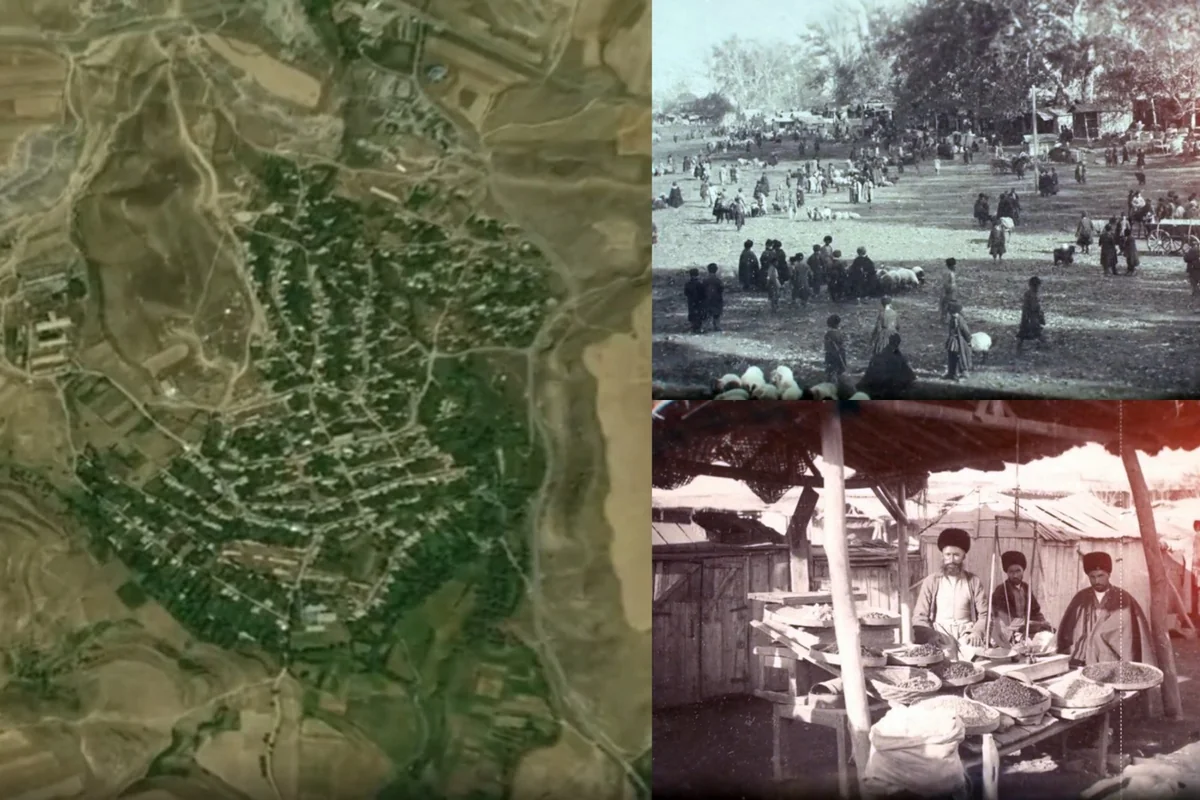
One of the first reports of a special project documenting the history, population, and tangible cultural heritage of settlements in Western Azerbaijan is dedicated to Shaki village.
The project is being implemented as part of the historical study titled "The Perished Civilization."
According to Report, the village, currently located in Armenia's Syunik Province, is referred to as Sheki and Shaki in sources. Documents from the Russian Empire period predominantly use the name "Sheki," while some sources use "Shaki." During the Soviet period, the name "Shaki" was used. Since 1995, the settlement has been part of Armenia's Syunik Province.
The project presents Shaki as a settlement in the Zangazur region and traces the village's history based on Ottoman registers, statistical publications from the Russian Empire, Azerbaijani and Armenian archival documents, studies by Armenian authors, press materials, epigraphic sources, and field research conducted in 2021-2024.
Name of Shaki in 16th–18th-century documents
Under the terms of the 1590 Treaty of Constantinople, which ended the Ottoman–Safavid War of 1578–1590, nearly the entire territory of the present-day Republic of Armenia came under Ottoman rule.13,14
In 1590, Ottoman officials compiled the Detailed Register of the Iravan Eyalet, which listed the names of settlements, including the village of Shaki.
Under the 1724 Russo-Ottoman Treaty of Constantinople, the territory of the present-day Republic of Armenia was recognized by Russia as part of the Ottoman Empire.
In 1727, the Ottoman authorities compiled the Detailed Register of the Nakhchivan Sanjak, which contained a list of settlements and information on their populations. The village of Shaki appears in the register.
In 1728, Ottoman officials drew up the Summary Register of the Iravan Eyalet, which recorded the names of settlements. The village of Sheki is also mentioned in this document.
From the mid-18th century until the Russian conquest, the territory of the village formed part of the Karabakh Khanate.
In the early 19th century, the Karabakh Khanate came under the authority of the Russian Empire. During the Tsarist period, the village was part of the Zangazur Uyezd of the Elisavetpol Governorate.
According to the Description of the Karabakh Province, compiled in 1823 on the orders of A. P. Yermolov, commander-in-chief in Georgia, Shaki was inhabited by ancestors of the Azerbaijanis. Mehdiqulu, the last khan of the Karabakh Khanate, granted the village to Haji Aghalar Bey, a major landowner.
Historical population statistics
The project compares statistical publications from the Russian Empire period with data from Armenian author Zaven Korkotyan's work "The Population of Soviet Armenia Over the Last Hundred Years (1831-1931)." In 1831, the village had a population of 48, and the project states that all of them were ancestors of Azerbaijanis. In 1915, 1,584 people were registered in the village, with the vast majority reportedly being ancestors of Azerbaijanis.
Events of 1918
One of the project's most extensive sections is dedicated to the events that took place in Zangazur in 1918. The material provides information about the decision of the government of the Azerbaijan Democratic Republic on May 29, 1918, to cede the city of Iravan to the Armenians, as well as the escalation of confrontations in the region amid territorial disputes between the newly established Republic of Armenia and Azerbaijan, Georgia, and the Ottoman Empire.
The authors characterize the violence against the Turkic-Muslim population in Zangazur and other regions in 1918-1920 as ethnic cleansing, stating that as a result, some of Shaki's Turkic-Muslim population were killed, while others were expelled from the village. Citing information published in the Georgian newspaper "Sakartvelo" in 1918, the material states that 95 people were killed in Shaki in August of that year, the village was destroyed, and the damage was estimated at 16 million rubles.
According to another document preserved in the State Archives of the Republic of Azerbaijan, 500 people, including 200 children, were killed in Shaki village in the autumn of 1918, while 156 people were injured. While the village had a population of 1,584 in 1915, only 294 people were registered in Shaki in the 1922 census. Of these, 282 were Azerbaijanis. The project links this sharp demographic decline to the consequences of the events of 1918.
The administrative fate of Zangazur
The material also provides information about the establishment of Soviet Armenia on November 29, 1920, and the decisions taken by the leadership of Soviet Azerbaijan regarding Zangazur the following day. According to the documents cited, the western part of the Zangazur district remained within the Armenian SSR, while the eastern part remained within the Azerbaijan SSR. Since 1930, Shaki village has been part of the Sisian district.
Azerbaijanis lived in Sheki during the Soviet era as well
According to statistical sources, Azerbaijanis continued to live in the village until the late 20th century. In 1926, Shaki had a population of 792, of whom 385 were Azerbaijanis.
The "Dictionary of Toponyms of Armenia and Surrounding Regions" puts the village's total population at 1,704 in 1970, 1,698 in 1979, and 1,449 in 1989. The project authors point to inconsistencies in the presentation of statistical data in the dictionary. According to them, although the dictionary cites the works of Z. Korkotyan, A. Manvelyan, and G. Martirosyan, all or some of the residents identified as Azerbaijanis in the original works are presented as Armenian residents in the dictionary.
At the same time, the Armenian toponymic source separately notes that Azerbaijanis left Shaki in 1988-1989. The project presents this in the context of the worsening Armenia-Azerbaijan relations over the Karabakh issue in the late 1980s and the mass migration of the Azerbaijani population living in the Armenian SSR.
Shaki used to have a mosque
The "Collection of Information about the Elisavetpol Governorate," published in 1902, notes that a mosque was operating in Shaki village. The mosque has not survived to the present day. As part of the preparation of the book "Vanished Civilization," field research was conducted in Armenia in 2021-2024, including in remote mountainous areas, to identify and document historical and cultural heritage sites belonging to Azerbaijanis.
According to the project, an Azerbaijani cemetery was discovered during research conducted in Shaki village. Several dozen destroyed and damaged gravestones are reportedly still standing in the cemetery.
The work "Corpus of Epigraphic Monuments of Azerbaijan" by Mashadikhanym Neymat also reportedly records an Arabic inscription characteristic of the 14th century on one of the gravestones in Shaki village. The project's page dedicated to Shaki contains 36 written sources. These include statistical collections and legislative acts of the Russian Empire, materials from the State Archives of the Republic of Azerbaijan, statistical and administrative publications from the Armenian SSR period, works by Armenian authors, Ottoman registers, the newspaper "Sakartvelo," The Scotsman, a study by Richard Hovannisian, and other materials. The page also contains 53 photographs related to Shaki village and examples of historical heritage documented there.
The "Sites of Memory of Western Azerbaijan" project is presented in Azerbaijani, Russian, and English.
